
STEEL CONDUIT TUBE | WHAT TO LOOK FOR
Within electrical wholesale and more specifically cable management, steel conduit tube is one of the most widely used and in demand products on the market. So how do you know the brand you’re buying is up to standard? And will it offer your customer the coveted ‘fit-and-forget’ experience?
No wholesaler wants their customers to have a bad experience with the products they sell. Resolving situations like these takes time and costs money, both of which are currently at a premium as we make our way through the ongoing coronavirus pandemic.
Here are three things to look for when sourcing your steel conduit tube and why they’re important.
One: British Standards
Written and designed to ensure conduit tube is manufactured responsibly, British Standards are the foundation of a reliable and quality product. In the UK, the current standard for steel conduit tube is BS EN 61386-1:2008+A1:2019. Covering every aspect of tube from the material tensility to a series of tests which a manufacturer must carry out, this Standard was updated in January 2020 with the addition entitled ‘+A1:2019’.
This latest update introduces the requirement for all lengths of steel conduit tube to feature extra marking information in the form of four numbers, each of which relates to a performance indicator from the Standard; compression class, impact class, lower temperature range grade and higher temperature range grade, as shown on the image below.
Two: LUL Authorisation
Carrying up to 5 million passengers per day through a complex network of tunnels running under London, the tube is arguably one of the harshest environments for cable to be installed and so requires only the highest quality steel conduit tube to protect it.
With over 500 trains in operation during peak times, the constant buffeting of steel conduit by passing carriages mixed with a predominantly colder atmosphere, ingress of water from the city streets above and ingress of dust from the air pressure, the London Underground is an extreme environment and one that can accelerate rusting and metal decay.
LU (London Underground) Standard 1-085 was developed as an internal Standard however has now grown through its strict control guidelines and rigorous approval process to become a widely recognised performance indicator throughout the construction industry.
LUL Authorisation and the correct supporting documentation are a mark of quality for steel conduit tube and the complimentary accessories.
Three: Wall Thickness
Despite being manufactured from pre-galvanised steel and supplied in rigid lengths of either 3 metre or 3.75 metres, steel conduit tube is designed to bend. When working in large industrial settings or on major projects such as Crossrail, conduit systems can become very complex and frequently require flexibility in their design through conduit bending.
Steel conduit tube can be manipulated into 90o bends using a dedicated tube bending machine. However, this approach can invite issues of its own, particularly if the conduit tube has been manufactured using a thin wall.
Scenario. A contractor needs a bend in the tube as part of the installation. They place the conduit length onto the bending machine and apply the correct technique to create a smooth bend. Unfortunately, the wall thickness is too thin and results in a breaks, fractures or cracks making this length now useless as not only has the protective steel wall been broken, the sharp edge is likely to damage wires or cables as they are pulled through later.
This issue now requires your customer to contact you and sort it out, typically with significant time pressures as scenario’s like this can delay ongoing work as replacement stock is arranged and re-delivered; not to mention how cumbersome and expensive conduit tube is to transport. This also costs you valuable time and cost which could have otherwise been used on your next enquiry.
Cost vs Quality:
We understand how important prices are. Even before the Covid-19 pandemic, cost was often a deciding factor between one supplier and another and an accepted part of the every day.
As the world and our industry now begin to rebuild, simply focusing on cost is not enough. Product quality must now take the lead so that we can get things moving, save ourselves time & money and also continue building confidence at every stage of construction.
Please share this article with your network so that we can ensure only the right product is being used for the job.
Metpro Make It Easy:
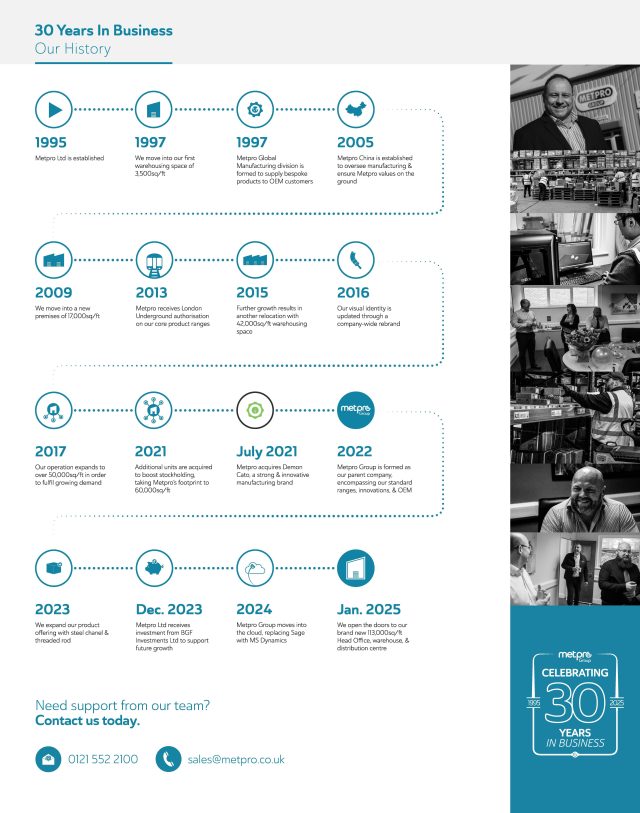
At Metpro, quality has been an integral part of our business since 1995, from product to customer service.
This is no different in the manufacture of our steel conduit tube range. We are proud to have full LUL Authorisation on all our relevant steel tube products, all of which are also compliant to BS EN 61386-1:2008+A1:2019 to the highest classification.
In order to prevent any scenarios like we have shown in this article, our 20mm and 25mm conduit tube lengths are manufactured with a minimum wall thickness of 1.37mm. With the full range of tube stocked at Metpro, we have also catered for our larger diameters of 32mm, 1” and 2” by ensuring even thicker walls to prevent any breakage or fracturing, meaning you and your customer can be confident that our product is up the task.
Further guaranteeing the strength of our product, we also permanently mark our tube instead of impression print so as to maintain the structural integrity of each and every length.
Our dedicated conduit tube warehouse is fully stocked, carrying up to 1200km of steel tube in both hot dipped galvanised, pre-galvanised and black finishes. You can also check our live stock levels at www.metpro.co.uk.
If you’d like to find out more or to discuss your requirements, give us a call on 0121 552 2100 or email [email protected].